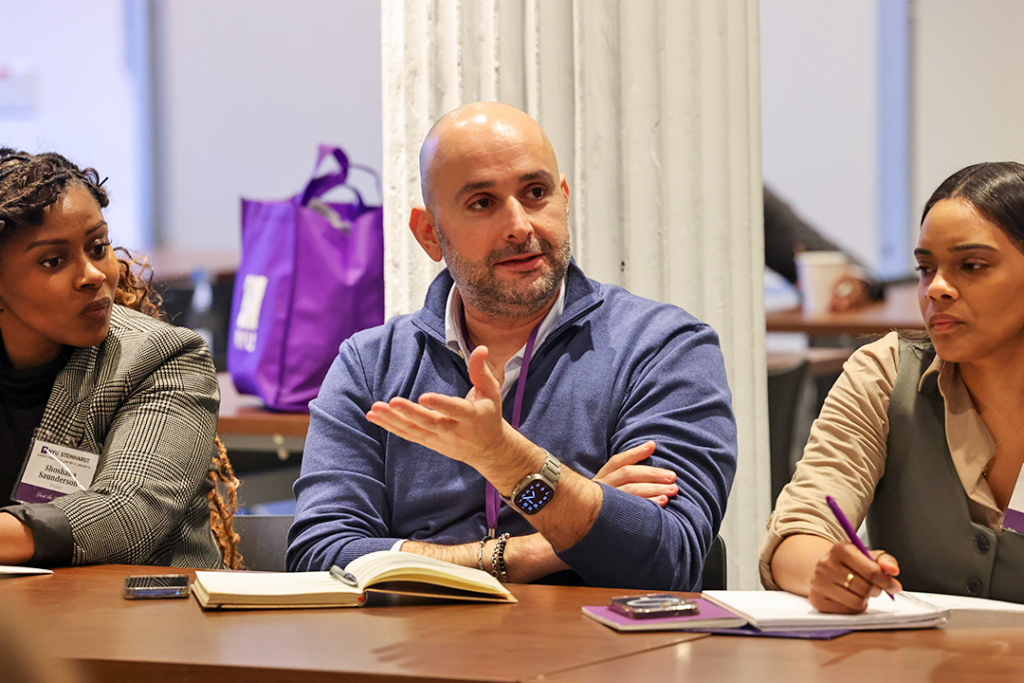
Even the most accomplished professionals can face self-doubt when beginning a doctoral program. That feeling—known as imposter syndrome—is the persistent belief that one doesn’t belong or isn’t truly qualified, despite clear evidence of success. This quiet insecurity surfaces early for many entering advanced academic study.
Students in NYU’s EdD in Leadership and Innovation arrive with impressive credentials: they are superintendents, principals, nonprofit directors, corporate managers, and entrepreneurs. With years of leadership experience, they bring a strong track record of achievement. Still, many describe their first days in the program as marked by hesitation. Surrounded by equally accomplished peers, they ask themselves, “Do I belong here?”
This article shares the voices of NYU EdD students and alumni who faced imposter syndrome directly. Their stories reveal how common the experience is, how faculty and peer support help students overcome it, and how graduates leave with a degree and a renewed confidence in their leadership. Their insights offer valuable guidance for anyone considering a doctoral journey.
Move Beyond Fear and Into Transformational Impact
Graduate Prepared to Solve Systemic Challenges
Imposter Syndrome in Doctoral Studies
Imposter syndrome often surfaces in high-achievement environments. Doctoral programs are no exception. Students enter these programs with careers marked by leadership and accomplishment, yet the shift to becoming a learner again can leave even seasoned professionals feeling unsteady.
Several factors contribute to this experience.
Constant Comparison
Graduate cohorts are filled with professionals who bring impressive résumés, advanced roles, and unique experiences; simply reading classmates’ biographies can spark self-doubt. NYU EdD student Brian Moreno recalled, “Everybody here is very talented, very accomplished. What am I doing in the room?” At a group dinner, he was surprised to hear others voice the same concern: “I, too, have imposter syndrome.”
High Expectations
Doctoral work demands complex research, deep analysis, and sustained writing. For students used to excelling in professional settings, the academic transition can feel daunting.
Systemic Barriers
First-generation doctoral students and those from historically marginalized communities often face additional challenges. Academia hasn’t always been equally accessible, and structural inequities can intensify feelings of not belonging.
The Nature of Leadership
Leaders are used to guiding others. In a doctoral setting, they return to the role of learner, a shift that can feel disorienting. The humility required can open the door to self-doubt.
EdD student Noé Orlando Escobar described his first residency as a mix of excitement and anxiety. “It was exciting, but also very nerve-wracking… It’s that imposter syndrome,” he said. His experience reflects how quickly these feelings can arise, even in supportive academic environments.
What becomes clear is that imposter syndrome is common in doctoral study, particularly at the outset. Recognizing this shared experience is the first step toward overcoming it.
Overcoming Self-Doubt and Finding Belonging
Imposter syndrome thrives in isolation, but it loses power in community. From day one, NYU’s EdD in Leadership and Innovation is designed to foster connection. Through a cohort model, students progress together, building trust and supporting one another. This structure reinforces a central message: you belong here.
“You were selected with purpose, and you belong here. You were chosen for a reason,” said EdD student Noé Orlando Escobar. “That reassurance has been extremely helpful.”
The program emphasizes that admission is intentional: students are chosen because their voices matter, their experiences are valuable, and their perspectives enrich the group. With that understanding, many begin to shed self-doubt and recognize the significance of their contributions from the start.
The cohort model also creates opportunities for collaboration across industries. A superintendent may sit beside a nonprofit leader; a corporate manager beside a school principal. Together, they build a shared language for leadership and problem-solving. Their diverse insights spark innovative approaches to challenges across the education, business, and community sectors.
“This is the right program if you want to build a community, collaborate with partners, and go through a shared experience,” said student Brian Moreno. “Here, we’re really looking for that overlap and collaboration.”
Faculty play a key role in reinforcing this sense of belonging. Professors act not just as instructors but as mentors, advocates, and thought partners. They bring decades of leadership experience into dialogue with students’ lived realities, affirming that every voice matters.
Belonging doesn’t eliminate the rigor of doctoral work. Courses are challenging and projects require sustained effort. But with the support of a trusted cohort and the guidance of invested faculty, students find their footing. What once felt like personal weakness transforms into a shared journey marked by growth, resilience, and renewed confidence in their leadership.
Advice from Alumni on Pushing Through Imposter Syndrome
Alumni of NYU’s EdD in Leadership and Innovation speak candidly about their early struggles with imposter syndrome. Their reflections offer reassurance to those who are just beginning the journey.
Dr. Keane Johnson (EdD, Cohort 3) vividly recalled his first residency. “I reflect back on the end of day one of the residency. I was like, Who are these people? What are they talking about? What did I get myself into? Am I built for this? My day job is going to suffer. I’m going to have a degree and no job. That’s what I was thinking.” His message to prospective students now is clear: “You belong here. You were chosen for this program for your unique perspectives, experiences, and potential. Trust the process, trust your community, and most importantly, trust yourself.”
Other alumni echo that advice, especially the importance of embracing the student identity. “Lean into your NYU identity,” one said. “You belong. You belong.”
Their insights come with practical strategies for pushing through doubt:
- Lean on the cohort: Share challenges, ask questions, and offer support. Collective strength eases individual burdens.
- Reframe difficulty: A tough assignment isn’t evidence of inadequacy; it’s a sign of growth and learning.
- Trust the admissions decision: You were selected for a reason. Others saw your potential, even when you question it.
- Stay connected to purpose: Remember why you entered the program. That sense of mission can carry you through uncertainty.
Alumni stories are powerful because they complete the narrative. The same people who once questioned their belonging now hold doctoral degrees—and the confidence that comes with them. Their experiences affirm a simple truth: imposter syndrome doesn’t define the journey, and it doesn’t last.
From Self-Doubt to Leadership
For those considering NYU’s EdD in Leadership and Innovation, the experiences of students and alumni offer both caution and reassurance. The caution: imposter syndrome is real, and even the most accomplished leaders feel it. The reassurance is that it’s temporary, and overcoming it can strengthen your leadership.
Imposter syndrome isn’t a sign of failure; it’s a signal of growth. It often arises when individuals step outside their comfort zones and into new challenges. “You have to challenge yourself,” said student Noé Orlando Escobar. “You’re going to get out of your comfort zone.” That discomfort is part of the learning process, a sign that meaningful development is underway.
At NYU, students don’t face these moments alone. The program’s cohort model, engaged faculty, and alumni network provide consistent support, encouragement, and guidance.
Graduates leave with more than a degree. They gain the confidence to trust their voice, vision, and leadership. They learn that while self-doubt may arise, it doesn’t define them. What lasts is the growth forged through community.
For prospective students, the message is clear: don’t let imposter syndrome stand in your way. NYU’s EdD program offers a supportive, collaborative environment where you can sharpen your skills and strengthen your confidence as a leader.
Take the next step: explore the curriculum, attend a program overview, or start your application today. Embrace the challenge—and turn self-doubt into confident, purpose-driven leadership.