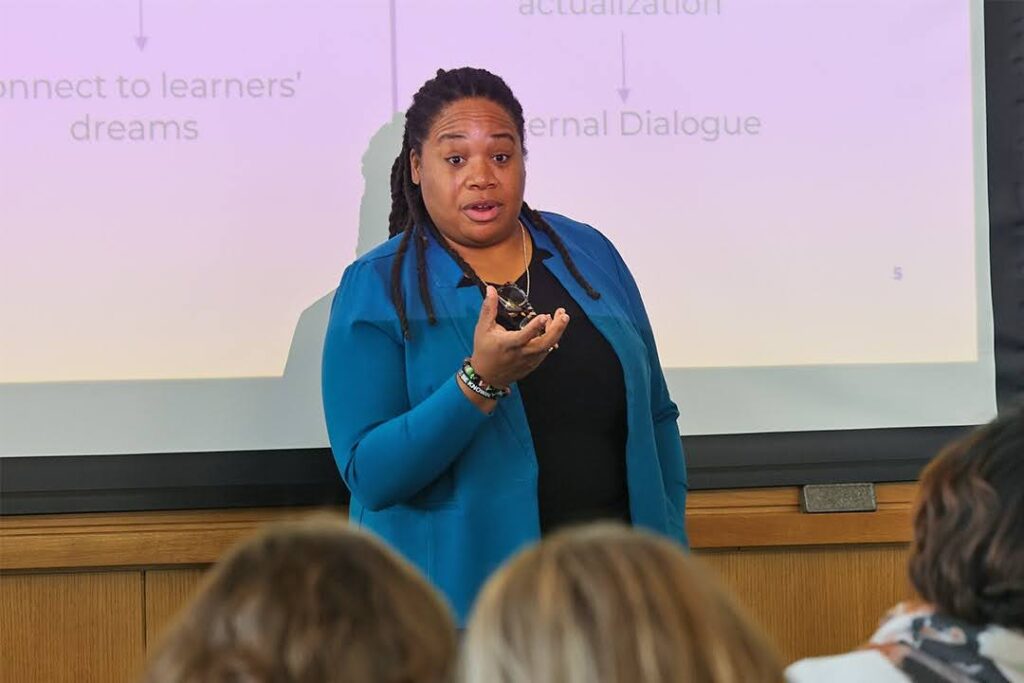
On a cold January morning, the newest cohort of EdD in Leadership and Innovation students gathered at NYU’s Jay Street building in Brooklyn for their first immersive residency. The event marked their introduction to doctoral study, an intense day of discussion, collaboration, and academic challenge designed to set the tone for the journey ahead.
Their scheduled sessions included Organizational Theory, taught by Dr. Jennifer Hawkins, a program alumna now serving as faculty. Before exploring leadership models or organizational structures, Hawkins had something different in store—an exercise that would challenge how students approached problem-solving, collaboration, and leadership itself.
Discover the Leader Within You at NYU
Join a Community of Innovative Change-Makers
The Challenge of Returning to Academia
Dr. Jennifer Hawkins began the session by handing out a series of images. Some were close-up details, while others were wide-angle landscapes. Her only instruction:
“Look at your image and figure it out. Show me just how chatty you can be.”
At first, students sat quietly, examining their individual images. A few compared notes with neighbors, but most remained focused on their own tasks. Gradually, conversations sparked as they tried to determine how the images might connect.
Then Hawkins paused the exercise with a simple but revealing question:
“Who can tell me what the first thing was that I said before we started this activity?”
A murmur spread through the room as students realized they had overlooked a key part of the instructions: they were meant to around and talk to each other from the start, not work in isolation.
As they finally began engaging with more classmates, one remarked:
“I think it’s a zoom out—I think we’re zooming out.”
Momentum shifted. The group began assembling the images into a single narrative, zooming out from fine details to a sweeping, panoramic view.
But Hawkins wasn’t just interested in whether they had completed the task. She wanted them to reflect on how they had approached it.
She noted that while they eventually succeeded, their progress was slow because they initially focused too much on individual pieces rather than collaborating from the outset.
“As adult learners,” she noted, “we’re focused on the task. We’re focused on what we see in front of us, and we have to execute.”
Weaving in concepts from recent coursework, Hawkins emphasized a key insight: adult learners often unconsciously discard valuable information and assume expertise too quickly.
“Without instruction, or even with instruction, how much information do we just discard unconsciously? And what does that do to our learning?” she asked. “It’s very easy as adult learners to take what we think we need and discard the rest. Even though we were given a seven-course meal, we’re only going to eat these two courses. And then we’re like, ‘Yeah, I’m an expert.'”
That narrow focus and tendency to overlook or filter information, she warned, can keep leaders from seeing the full picture—or from bringing others along in the process.
Breaking Self-Imposed Boundaries
One of Hawkins’ key observations focused on how students had inadvertently created limitations for themselves during the exercise and made it harder to see the big picture.
“We have the floor, we have chairs,” she pointed out. “I would have happily gotten some tape to put [the images] up on the wall.”
Her point underscored a common challenge for both learners and leaders: failing to recognize when simple resources or adjustments could ease the task. The exercise became a powerful lesson in how people often operate within perceived constraints without questioning whether those boundaries are real or self-imposed.
One student later reflected that focusing narrowly on image details made it harder to see the broader connections—until a peer helped them zoom out. Another noted that the activity prompted a shift in how they approached learning within their cohort, realizing the importance of seeking support and adjusting perspective.
Leaders vs. Collaborators
One key lesson from the exercise? The difficulty many professionals face when shifting from leading to collaborating.
Students in the program are senior-level professionals accustomed to developing solutions and directing others, not stepping into fully collaborative roles. Hawkins noted that even in group settings, students tended to default to individual problem-solving rather than collective strategizing.
“How often do we just not let go of our piece even when someone tells us, ‘I can’t see the whole picture?'” she asked. “Set it down. Set it down and let them see the whole picture so that you can bring them in.”
In one case, a student correctly identified early on that the image was a “zoom-out,” but their insight was largely ignored instead of becoming a focal point. Another classmate noted that one participant had three images while others had only one, giving them a broader perspective and underscoring how individuals may unknowingly hold key information that could benefit the entire group.
One student reflected that simply following instructions—listening carefully and acting accordingly—was critical to success. The experience highlighted how easily collaboration can be derailed by assumptions or inattention.
More Than Just a Course
Hawkins’ Organizational Theory class delivers a deeply personal learning experience. Students aren’t just absorbing theories; they’re learning to challenge assumptions, navigate complexity, and grow as leaders.
While many began the course focused narrowly on their own piece of the puzzle, they soon discovered that true leadership—and meaningful learning—requires stepping back to see the bigger picture.
Featured Faculty: Jennifer Hawkins
Dr. Jennifer Hawkins brings a unique dual perspective to the EdD in Leadership and Innovation program as both an alumna and a faculty member. Having navigated the same academic journey, she offers firsthand insight into the challenges and personal growth the program demands, making her a powerful mentor for current students.
Outside the classroom, Dr. Hawkins serves as chief of staff at New Profit, a venture philanthropy organization that unites social entrepreneurs and funding sources to promote innovation, equity, and success. Her experience leading in diverse, cross-sector environments reflects a core strength of the EdD program: learning alongside professionals from a wide range of industries.
Deeply committed to equity, leadership development, and lifelong learning, Dr. Hawkins challenges her students to think critically, engage fully, and apply their knowledge to create meaningful impact—both within their organizations and in the wider world.
Redesigning Systems, Not Just Working in Them
To lead meaningful change, you must first understand the system you’re working within. Organizational theory provides the tools to analyze, question, and ultimately redesign those systems, rather than simply operate inside them.
The EdD in Leadership and Innovation program equips students with this critical lens, empowering them to drive transformation in their organizations and communities. If you’re ready to move from managing change to leading it, take the next step by scheduling an application walkthrough or starting your application today.