Prospective doctoral students almost always ask the same straightforward question: Will this program actually connect to the work I’m doing every day? Advanced degree programs sometimes operate at a remove from professional life — rich in theory, light on application. For people already in the middle of consequential work, that gap matters.
The NYU EdD in Leadership and Innovation (EdD) is designed to close the gap. At the center of the program is the Problem of Practice (POP). It’s not a dissertation in the traditional sense, but a sustained investigation of a real challenge each student is actively navigating in their professional life. The POP isn’t something the program assigns. Students bring it with them. And importantly, they’re encouraged not to finalize it right away.
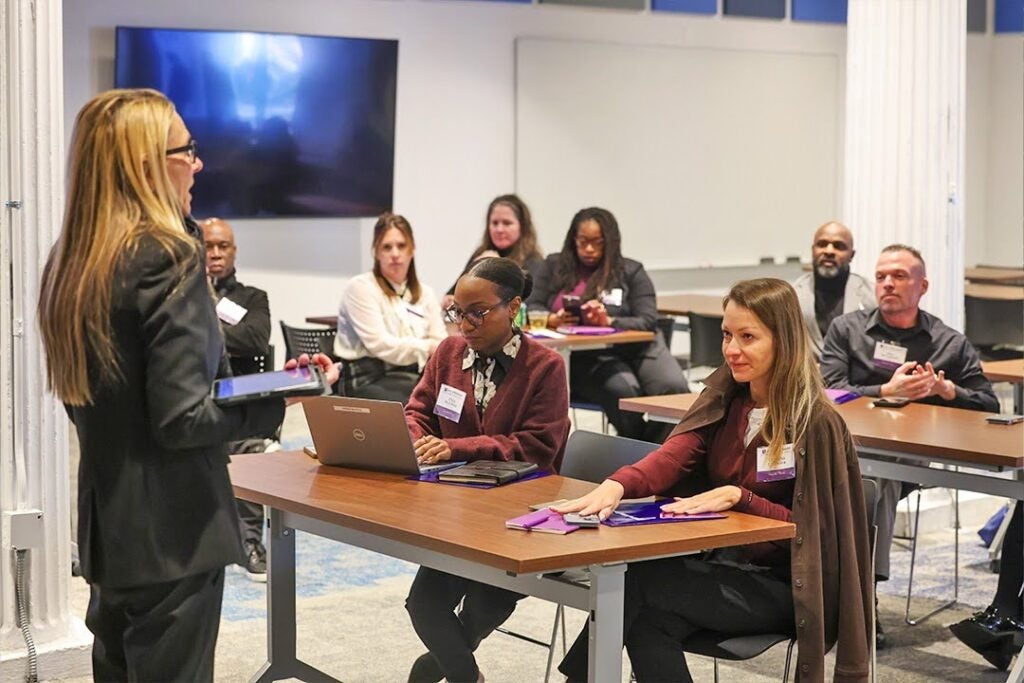
When Cohort 9 arrived at residency, they came carrying problems drawn from K–12 schools, county health systems, federal agencies, universities, and corporate leadership pipelines. These were not hypothetical case studies; they were the actual challenges these leaders faced in their organizations. The program was designed to help them see those challenges with new depth and precision.
Transform Your Workplace Challenge Into Your EdD
Apply Doctoral Research Directly to Your Current Role
What a Problem of Practice Really Is
A Problem of Practice is a persistent leadership challenge rooted in a student’s current professional role. It can center on organizational culture, equity, resource allocation, systems design, or human development. Whatever its specific focus, the challenge must be real and something the student is actively working to change.
What the program asks of students is patience with that problem. The POP is intentionally revisited and refined as students gain new frameworks through coursework and engagement with their cohort. Arriving with a clearly defined problem is a reasonable starting point; arriving with a fully finalized one can be a limitation. The program is designed to change how students understand their organizational realities, not merely to equip them to solve a problem they’ve already diagnosed.
Tonya Breland, an EdD alumna who returned to speak with Cohort 9 at residency, highlighted this need for a more deliberate approach. She noted that because many students already hold executive positions, they might feel compelled to implement quick solutions. However, she explained that when addressing a POP, “They’ll need to be thoughtful about how they create that improvement in their organizations.” Simply dictating a solution from the top down is rarely successful; she reminded the cohort that “To go in and say, this is how we’re going to do it is not going to be the most effective approach.”
Instead, the program encourages leaders to expand their analytical lens and question their existing institutional frameworks. Breland suggested that students push themselves to look beyond immediate operational fixes by asking, “Am I considering the voices of those who typically are not at the table? Am I thinking about how policy impacts everybody in an equitable way?” Ultimately, this process forces students to critically examine organizational outcomes, ensuring they are constantly evaluating “the impact of decisions and how they may move us in the right or the wrong direction.”
A Cohort That Brings Diverse Problems Into the Room
The cross-sector composition of the EdD cohort is central to the POP’s development. Cohort 9 includes leaders from K–12 and higher education, corporate environments, government, public health, and human spaceflight operations. Each student works on a distinct institutional challenge shaped by the specific demands of their industry.
What these leaders share is a common professional disposition. They recognize that their current tools are insufficient for the organizational complexity they face, and they are willing to pursue a more rigorous, research-driven path to institutional change.
Warren Lee, principal music director of a group of twelve schools in Asia, arrived at residency with that openness already in hand. When his circumstances shifted between his application and the start of the program, he reached out to program leadership and received advice that captures the EdD philosophy well. As Lee recounted: “When I emailed [former Program Director] Trish Beck to let her know the circumstances around my proposal had changed, she replied: ‘Take your time. Come here, it will evolve, and you will find your way.”
The Range of Problems Students Are Working to Solve
The Problems of Practice in Cohort 9 reflect the genuine diversity of the fields these leaders represent.
Systems, Equity, and Community Impact
Some students focus on systemic challenges with direct consequences for vulnerable populations. Crystal Walthall, executive director of a social justice community-based organization in Yonkers, New York, examines burnout and sustainability among Black faith leaders and social justice organizers. As she described it: “There’s a trend that we have seen in our work that organizers — particularly Black organizers — only last about two to three years in the work… The work takes a toll on the mind, body, and spirit.” Her POP is oriented toward building new models of healing-centered leadership that can sustain the people doing this work over time.
Sheena Smith, who runs county-operated addiction services and clinics in St. Lawrence, New York, is investigating food insecurity as a barrier to recovery and wellness. “Among our clientele, only 65 percent have food stamps. And even when they do have food stamps, by the end of the month, they’ll be like, we’re hungry, we’re out of food,” she explained. Her POP looks at how addressing that gap can improve outcomes for the clients she serves.
Organizational and Leadership Challenges
For other students, the work centers on taking successful organizational practices and turning them into scalable, codified strategies. K. Bain, CEO and founder of Community Capacity Development in Brooklyn, has spent a decade building a human justice framework that has successfully curtailed violence in every community where it has been contractually applied. Now, he wants to go further:”I want to codify this framework. I want to build an emerging evidence-based model, and I want to replicate and scale.”
Malika Clinkscales, vice president of university mentor strategy and operations at Western Governors University, is developing a unified mentoring strategy across an institution with four schools and up to 500 mentors serving 50,000 students. “The mentor model at WGU is the secret sauce,” she said. “It’s existed for years even though there has not been a unified strategy for mentoring.” The close alignment between her new corporate role and the POP framework was, in her words, “almost hard to believe.”
Education and Institutional Change
Several Cohort 9 members work in educational settings and grapple with questions of institutional effectiveness. Gamal Gittins, an assistant professor of military science and operations officer for the military, is working to build “a holistic academic advising model for cadets. The goal is to create a link, a bridge between the institution, the academic advisors, and the ROTC program in order to increase the graduation and commission rates.”
Shoshana Saunderson, a K–8 principal at an independent charter school in Philadelphia, is focused on translating her school’s strengths in culture and identity work into measurable academic outcomes, a challenge made concrete by charter renewal conditions requiring specific academic gains. Meanwhile, Khulan Tsenddoo, a school principal and owner in Ulaanbaatar, Mongolia, explores parental involvement and adult learning at a school she has run without ever having needed to work directly with adults as learners before.
Innovation and Emerging Contexts
Crystal Lister, an operational psychology specialist at NASA’s Johnson Space Center, brings a unique context to the program. Her POP sits at the intersection of leadership, organizational communication, and the systems supporting human spaceflight. As she described it: “How are we looking at processes and procedures with leadership, organization and communication on the administration side where we can ultimately improve human spaceflight?” The work extends to food and psychological studies in preparation for deep space missions, including Mars.
Lister’s work reflects a core truth about what the EdD program makes possible: a serious, research-backed examination of a real leadership challenge is valuable regardless of whether it unfolds in a school building or a launch facility.
How the Problem Evolves Over Time
Students often arrive at residency with a specific sense of what their POP is. That familiarity is a genuine asset, but it is also something the curriculum deliberately challenges.
Early in the program, students encounter numerous new ideas, frameworks, and perspectives in a compressed period. This influx of information frequently produces an immediate impulse to revise or abandon the original POP. The program’s guidance is to resist that early urge. Faculty encourage students to stay with their original problem, let the new frameworks settle, and allow meaningful revision to emerge from deliberate reflection rather than initial excitement.
Dr. Jennifer Hawkins, a clinical assistant professor and EdD alumna who now teaches organizational theory in the program, described how this looks: “By the time they’re through that first year, students are like, ‘OK, I’m still learning, and I’m in a different place. I’m now in a space where I can tackle the PoP.” Crystal Lister adds: “You think you have it all mapped out when you arrive; you have no idea how much the curriculum is going to transform and shape you. You have to take your time. You don’t know what you don’t know.”
From Problem to Practice: What Happens Next
As students move through the curriculum, their perspective begins to shift. What started as an isolated professional challenge starts to look like a specific instance of a much larger pattern visible across different industries and organizational contexts. While individual problems are genuinely different, the underlying dynamics, such as organizational inertia, leadership gaps, and the distance between stated values and operational reality, are frequently the same.
Jayson Jones, a student from a previous cohort who returned to speak with Cohort 9 as he prepared to defend his own POP, described the moment that recognition took hold: “The exciting insights emerged after sitting in conversations, sitting in classrooms, and realizing that we’re all dealing with the same types of problems, but it’s happening in our specific industries. That gave me confidence; I thought, ’OK, I’m in the same boat as all of these folks. We’re trying to tackle the same things.’”
This convergence from an individual problem to a collective insight is what gives the POP its force as a vehicle for change. The work remains specific to your unique organizational context and community. However, the research, the frameworks, and the sustained engagement of the cohort shape it into something much more rigorous and useful than it ever could have been alone.
Bring Your Work With You
The EdD program is built to meet you exactly where you are today. Your current leadership challenge — no matter the sector or the scale — is the ideal starting point for this work. You do not need a new role or a finalized set of answers before you arrive; you simply need the willingness to examine your organization with fresh eyes.
To learn more about this unique program, reach out to an enrollment advisor. If you’re already convinced that the NYU EdD is the program for you, you can begin your application today.