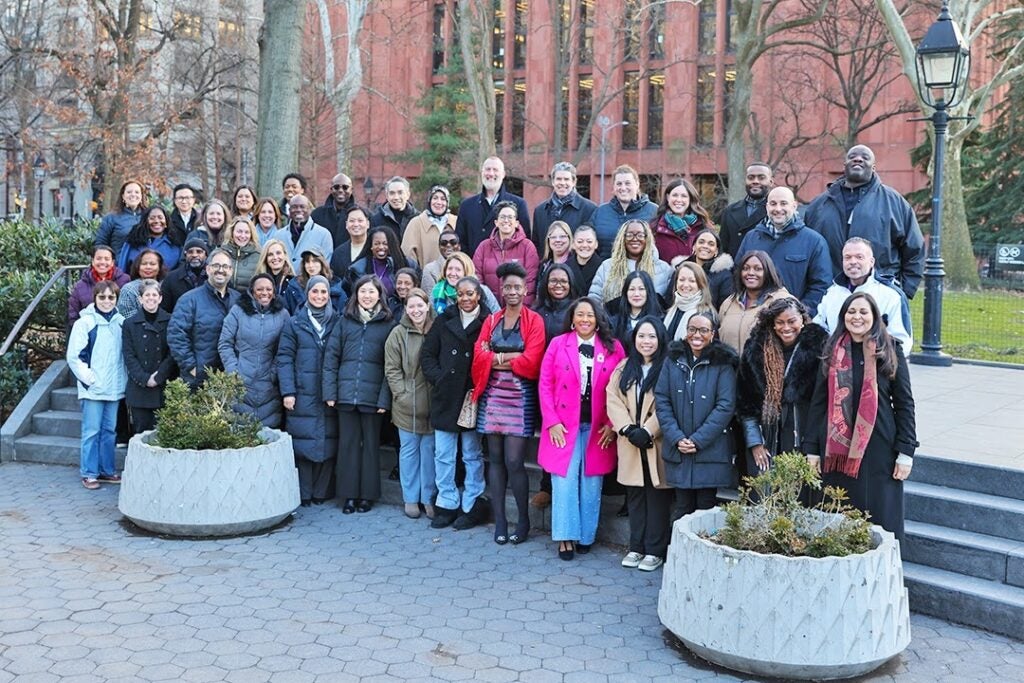
Every year, an elite cohort of cross-sector executives, healthcare leaders, military officers, and senior administrators gather on the NYU campus to launch their doctoral journeys. They arrive possessing diverse professional expertise, yet many carry the quiet, shared uncertainty that naturally accompanies a major academic commitment.
Over the course of three intensive days, this initial apprehension gives way to profound professional camaraderie. By the conclusion of the experience, they constitute a deeply bonded community of scholars.
This transformation is the deliberate result of the required immersive residency that serves as the official launch of the NYU Steinhardt Doctor of Education (EdD) in Leadership and Innovation. Long before the first online course begins, this required in-person programming establishes both the rigorous academic scaffolding and the relational foundation necessary to sustain full-time working professionals through two years of advanced graduate study. To elucidate the intentionality driving this model — and why the program views this immersion as a non-negotiable prerequisite — this article draws on an interview with former executive director Dr. Trish Beck, along with insights from faculty, students, and alumni who shape the experience.
Build Lifelong Ties with Global Executive Cohorts at NYU
Collaborate with Global Executives Across Diverse Industries
The Two Goals Behind Three Days
When Dr. Beck addresses incoming students on the first morning of residency, she is clear about what she wants them to take away. “There are two goals,” she explains. “The students should leave with a good sense of what the academic journey is going to look like: the Problem of Practice workshop, the writing sessions, the actual curriculum and the coursework. Then there’s the other piece, which is that they should leave with a sense of community.”
Those two goals — academic orientation and community formation — are not just introductory formalities; they are the structural core that makes a rigorous, virtual doctorate sustainable for working executives. Because the program operates primarily online, the university treats this initial in-person alignment as a strict, non-negotiable baseline. Program co-founder Dr. Lisette Nieves underscores the absolute necessity of this foundation, stating plainly: “If you’re not at residency, you’re not in the program. It’s that simple.”
This insistence reflects a proven strategy for doctoral persistence. While the national completion rate for doctoral programs hovers around 50 percent, this program achieves a 94 percent graduation rate. Dr. Beck attributes this dramatic statistical gap directly to the relational safety net established during these three days. The accountability forged on campus ensures that students never work in isolation, creating an environment where, as Dr. Beck recalls, an alumnus once recounted, “We’ll either pull you across the line or we’ll push you across the line, whichever you need.”
Building Community Across Sectors
The EdD cohort is deliberately cross-sectoral. Students come from for-profit companies, healthcare organizations, government agencies, nonprofits, higher education, and K–12 schools. That diversity is a feature, not a side effect — but it also means that students arrive at residency without a shared professional language or obvious common ground. The residency is where that changes.
Dr. Beck has watched this transformation happen year after year, and she still finds it remarkable. “They walk in on Monday morning a little uncomfortable; they’re meeting fifty-some-odd people. By Wednesday night, they’re hugging and crying when they say goodbye.”
The speed of that connection is not accidental. It is the result of careful programming that places students in collaborative workshops, panel discussions, and small groups, often before they have had time to register each other’s titles. As student Hailey Holt observed, “The cool part about residency is that all those titles are stripped. We’re all here for the same reason.”
That leveling effect matters. Student Serenity Smith noted that during the residency, “Not at one moment did I feel intimidated; I just felt inspired and ready to dive in and learn.” And student Juliet Neal pointed to what that kind of community means over the long haul of a doctoral program: “If you should stumble along the way, there are people who will be able to lift you up.”
Confronting Imposter Syndrome Head-On
It is common for students entering doctoral programs to question whether they belong, a feeling that persists even among highly accomplished and credentialed professionals. The EdD residency treats this anxiety not as a private struggle but as a shared experience worth naming aloud.
Dr. Beck addresses this vulnerability directly with incoming students. On the evening of the first day, when conversations about self-doubt were surfacing across the cohort, she offered this specific challenge to the room: “That self-doubt you’re feeling: I challenge you to reframe it as humility as you’re lying in bed tonight thinking about this first day. Each of you deserves to be in this place. Self-doubt will paralyze you. So, come back tomorrow, replacing that self-doubt with the sense of being humbled: ‘I’m humbled to be here and a part of this community.’”
For student Noé Orlando Escobar, the residency delivered exactly that reframe. He explained that the experience provided “the reassurance that I was selected with purpose and that I belong here. The residency made it real.” He left the campus convinced he was “chosen for a reason” and that his cohort had been “tactically crafted to be the best it can be.”
An Experience That Evolves
The residency is not a fixed script. Dr. Beck and her team review feedback each year and adjust speakers, panel structure, and session focus accordingly. “We learn every year,” she says. “We learn by doing, we learn by the feedback we hear from the students. So we pivot a little bit every year.”
One of the consistent areas of refinement has been speaker selection. “We’ve learned to be more thoughtful about that,” Dr. Beck explains, noting that a speaker who resonates across industries serves the cross-sector cohort far better than one whose work is sector-specific. This past year, that principle led to an invitation to Dr. Bernard Harris, the first African American to walk in space, who drew engagement from every corner of the room.
Panel programming has received similar attention. “We put a lot of structure around the panels,” Dr. Beck says. “We are very purposeful on who’s facilitating, because we know who’s good at providing potential questions before the panels and establishing what the goal of each panel is.”
At the same time, the team stays nimble during the residency, adjusting in real time based on how sessions land. That combination of careful preparation and in-the-moment responsiveness reflects the same adaptive leadership the program teaches.
Alumni as Evidence and Infrastructure
Perhaps the most telling measure of the residency’s impact is what alumni do after the program ends. This year, 54 alumni and current students volunteered their time and traveled from across the country — California, Georgia, Washington D.C. — to support the incoming cohort. “Who better to be our pipeline for the future students than an alum?” Dr. Beck asks. “They know what the program is.”
Alumni do not just return to cheer on newcomers. Many of the program’s instructors are themselves EdD graduates, and the community they built during the program has continued to foster professional collaboration long after graduation: alumni have co-founded nonprofits, launched podcasts, published articles together, joined each other’s boards, and spoken at each other’s institutions.
Dr. Felipe Henao, who completed the program in Cohort 1 and now serves as Dean of Students at New York Institute of Technology, described the residency as “probably one of the most valuable experiences. I think everyone comes in with a nervousness or just an anticipation of the unknown, and it helps really create expectations, set reminders for professionals about what they can expect in the program, and just start to create community.”
Current student Jayson Jones, who attended residency two years ago and returned on the eve of his final POP defense, reflected on that full-circle moment: “I truly believe that it has been transformational for me as well as my cohort mates. And honestly, I feel the excitement in the room. Someone on the panel said that they would do this all over again. And being around them, meeting some folks, I feel like I would do it all over again because I’ve enjoyed the experience so much.”
Dr. Trish Beck herself is among those who came into the program skeptical of the cohort model and left it changed. “I was indifferent about the cohort model. I thought it didn’t matter. I was busy; I just wanted to get my doctorate. But now I travel with the group every year, and I realize that I would not have made it through COVID and the program without that group of people.”
The Beginning of a Two-Year Journey
The residency is not a preview of the program. It is the program’s first act: the moment when the cohort becomes a cohort, when the Problem of Practice takes its first shape, and when students begin to understand what two years of doctoral work will actually require of them. As alumni Dr. Shadan Deleveaux told an incoming class: “Savor the process, it’s rare that we have this opportunity at this age to so fully engage our curiosity and invest in ourselves.”
Curious about what comes after the residency? Explore the EdD curriculum to see how the program unfolds across 17 courses and 42 credits. When you’re ready, visit the “How to Apply” page to take the next step.