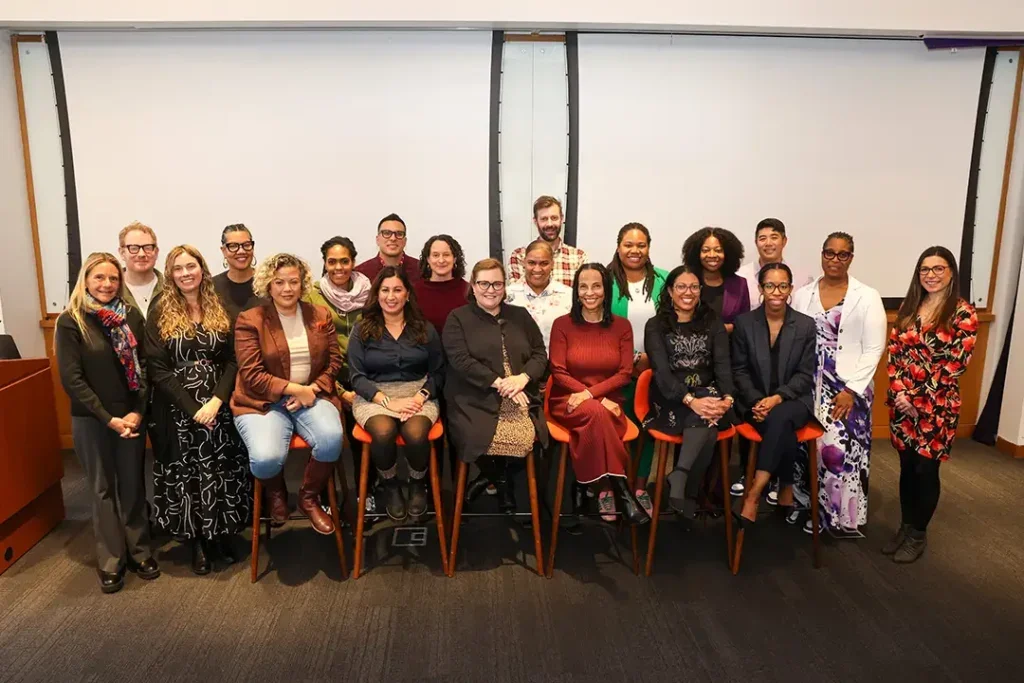
Three days. That’s all it took for a room full of accomplished strangers to evolve into a collaborative powerhouse of cross-sector leaders.
When Cohort 9 arrived at NYU’s campus for the 2026 residency, they came carrying impressive titles, years of hard-earned experience, and — almost to a person — a quiet, nagging question: Do I actually belong here?
By the time they departed, the answer had shifted profoundly, as imposter syndrome gave way to an unmistakable sense of belonging. As this intensive three-day residency drew to a close, members of Cohort 9 paused to reflect on this sudden transformation and what it means for the path ahead.
Learn From White House Advisers and Top Corporate Executives
Accelerate Your Executive Leadership Growth in Two Years
“You Chose Me”
The sense of belonging that emerged over those three days was not manufactured. It was not the result of a superficial icebreaker or a motivational talk. It grew, student after student said, from a dawning recognition that their presence in the program was entirely deliberate.
NYU’s EdD in Leadership and Innovation founders, Dr. Noel Anderson and Dr. Lisette Nieves, built the program around the principle of intentional selection. Each cohort is assembled with immense care, with each student chosen specifically for the unique perspectives they bring to a shared experience that spans sectors, continents, and careers.
That intentionality landed with a profound impact once the students were finally in the room together.
Moving Past the Paper Bios
For many, the initial intimidation of looking at their peers’ resumes dissolved the moment their colleagues spoke with transparency. Crystal Walthall, executive director of a social justice community-based organization in Yonkers, described the feeling: “It is very intimidating looking at the bios of fellow cohort members… but to be in this environment is to see the intentionality that Dr. Anderson and Dr. Nieves had in building this program, so I belong here. I am just as capable, just as intelligent, just as deserving as everyone else who is here.”
Malika Clinkscales, vice president of university mentor strategy and operations for Western Governors University, found herself searching for words to describe what that intentionality meant to her: “There’s not a feeling of being picked to fill a number; you were picked because of what you do and what you provide in the universe, and therefore this is the right place for you. That gives you a real deep sense of connection, and also of meaning and purpose.”
From Accomplished Strangers to Family
Cohort 9 student Gamal Gittins, an assistant professor of military science and an operations officer with the U.S. military, soon recognized “that sense of belonging” as the cohort grew to know one another. “There are a lot of people from different backgrounds, different cultures. In coming together, we realized we have a lot in common.”
Shoshana Saunderson, a K-8 principal at an independent charter school in Philadelphia who is also in Cohort 9, put into words the rapid evolution the entire room experienced after just forty-eight hours together: “On day one, we came in as strangers, and already it feels like family. We are already figuring out how to connect and support and uplift one another, and I feel like if this is how it feels day two, I can’t imagine what it’s going to feel like two years from now when we’re nearing the end.”
Words of Wisdom Across Cohorts
This reassuring realization isn’t unique to Cohort 9; it is a foundational truth echoed by the alumni who came before them. Tyler McCormick, a graduate from Cohort 6, offered a vital reminder that holds true across every incoming class: “Remember that you belong here. It’s so easy to be in a room with all these incredible, accomplished people and think, ‘What am I doing here? Do I belong here?’ You do belong here, and you have to keep reminding yourself that that’s true.”
Earning the Right to Feel Capable
Belonging is one thing. Believing in your own ability to succeed once you are there is another.
The students of Cohort 9 are, by any measure, remarkably high achievers. With a room boasting CEOs, military officers, school principals, managing directors, and NASA operational psychologists, the credentials present were formidable. And yet, imposter syndrome rarely checks credentials at the door. If anything, the more accomplished the room, the louder that inner voice can become.
The Shapeshifting Nature of Fear
Erica McGibbon, who manages program development, assessment, and accreditation for professional degrees at NYU, spoke with deep insight about the anatomy of self-doubt — and how the residency forced her to confront it: “It’s like you finally get over your fear of getting into the program. You get in, you’re so excited, but then you realize: ‘Buckle up for more discomfort.’ It is really about building the muscle of being afraid and doing it anyway.”
“Fear wears different masks; it disguises itself as different things,” she continued. “But when you take it apart, you realize, ‘Oh, I see what you are. I can do that.’ Overcoming it starts with gratitude — realizing how many things in your life right now were once just a dream or a wish.”
Leaving Self-Doubt Behind
During a core residency activity, students were asked to explicitly name what they wanted to leave behind as they began their doctoral journey. For Allison Graham Brown, executive director of a project at NYU, the answer was immediate: “For me, it’s really that idea of self-doubt. It’s easy to walk into a room and experience that imposter syndrome, asking, ‘Can I really do this?’ Right now, I’m in a room of people who are so inspiring and impressive, and it’s humbling to be a part of it.”
To break through that paralysis, Graham Brown leaned on advice delivered during the residency by former Executive Director Dr. Trish Beck: “Dr. Beck told us, don’t let that be your roadblock, and don’t let it paralyze you,” Graham Brown recalled. “Channel it, own it, and move forward with it.”
Completion, Not Competition
For other practitioners, confidence arrived the moment academic theory collided with their real-world expertise. K. Bain, CEO and founder of Community Capacity Development in Brooklyn, is already considered a global leader in community violence intervention (CVI). Yet, completing his very first program assignment unlocked a completely new layer of capability: “From the first paper I wrote and submitted on defining a term, I knew that I was in the right place. I explored CVI in a way that I had never done before, and upon completion, I knew that I was smarter. I had taken a moment to go deep into concepts that I somewhat took for granted.”
Bain also credited the collaborative culture modeled by his peers for lowering his defenses: “To have people open up and show that we are in a completion process, not a competition — to show that we’re here to support each other’s work — is invaluable.”
Omri Shick, Managing Director of Hebrew Public in Staten Island, summarized this mindset shift succinctly: “Change from self-doubt to humility, and ask the questions. Don’t be afraid to ask questions, and just be yourself.”
Trust the Process
Every student at the 2026 residency wore a nametag. And on every nametag, the exact same phrase appeared: Trust the process.
In a program crafted to push highly accomplished professionals back into the vulnerability of being a student — challenging the way they think, not just what they know — the reminder to release control is more than a superficial mantra. It is a necessary orientation for the journey ahead.
Giving Up the “Perfect Pathway”
Mashail Alnaimi, a manager at the CEO’s office at Qatar Foundation, noticed the message immediately: “Trust the process was the first thing that I read and felt I could resonate with, because there is no perfect pathway. All you can do is give it your absolute best, and then trust the process.”
Anne Alvarado, on active duty with the Army National Guard and working in global force management and readiness, heard the same message reinforced throughout the residency: “The resounding trend has been to trust the process and be open and vulnerable, which is nice for new students to hear because this is a long, two-and-a-half-year journey. We have to remember to pace ourselves, be present, be intentional with our learning, and be open to everyone else’s experiences to help shape our new mindset as scholarly practitioners.”
The Growth in “The Stretching”
For other practitioners, trusting the process means welcoming the intellectual disruption that comes with doctoral study. Crystal Lister, an operational psychology specialist at the NASA Johnson Space Center in Houston, described an eagerness to be genuinely transformed by the experience, rather than just completed by it: “You think you have it all mapped out, but you have no idea how much this time is going to transform, shape, and change you. That stretching is exactly what I’m looking for. I want to look back in two and a half years and say, ‘Oh my gosh, I’m a whole new Crystal.'”
Releasing the Weight of Guilt
Sometimes, trusting the process requires stepping away from life’s competing pressures to embrace personal growth. Khulan Tsenddoo, a school principal and owner of a private secondary school in Ulaanbaatar, Mongolia, arrived at the residency carrying a quiet burden common to executive doctoral students—the guilt of trying to be everything to everyone. A single moment during a group session shifted her entire outlook: “All throughout this time, I felt guilt for not being 100 percent home for my kids, 100 percent at work, and 100 percent at school. But during the residency, Dr. Anderson told us, ‘Do it for yourself.’ That just really stuck with me. Moving forward, I’m going to do it for myself.”
A Room Transformed
The cohort model is at the heart of the EdD in Leadership and Innovation. Students travel the curriculum together, building a common language and a shared sense of purpose across sectors and time zones. The residency is where that model becomes real for the first time, shifting rapidly from a program feature into a lived, foundational reality.
For the practitioners of Cohort 9, what began as a room of accomplished, uncertain strangers became, in just three days, the definitive beginning of a lifelong community. Marcy Leonard, Chief Operating Officer for Public Services for Howard County Library System in Columbia, Maryland, captured that collective shift perfectly: “The doctoral journey is not one that any of us are traveling alone. We truly have a community of scholars and humans to lean upon and work with.”
That collective energy — the late conversations, the honest admissions, the shared relief of finding out that everyone in the room felt the same anxieties — is something that cannot be replicated online or described in a brochure. It has to be lived.
Carrying the Network Forward
As the 2026 residency drew to a close, the members of Cohort 9 prepared to return to their respective corners of the country and the world, from New York and Houston to Virginia, Hong Kong, Qatar, and Mongolia. They will return to managing their vital leadership roles, balancing their families, and tackling their doctoral studies all at once.
There will undoubtedly be challenging days ahead. But as they return to their day-to-day work, they carry a powerful new asset: a dedicated cohort, a global professional network, and the profound knowledge that they were chosen for a reason.
Take Your Next Step
If you are a cross-sector leader ready to move past self-doubt, stretch your leadership capabilities, and solve persistent organizational challenges, your own community of practice is waiting.
- Ready to learn more? Reach out to an enrollment advisor today to discuss how the EdD curriculum and cohort model can elevate your career.
- Ready to join us? If you have seven years of leadership experience and a master’s degree, take the first step toward our next cohort by starting your application today.