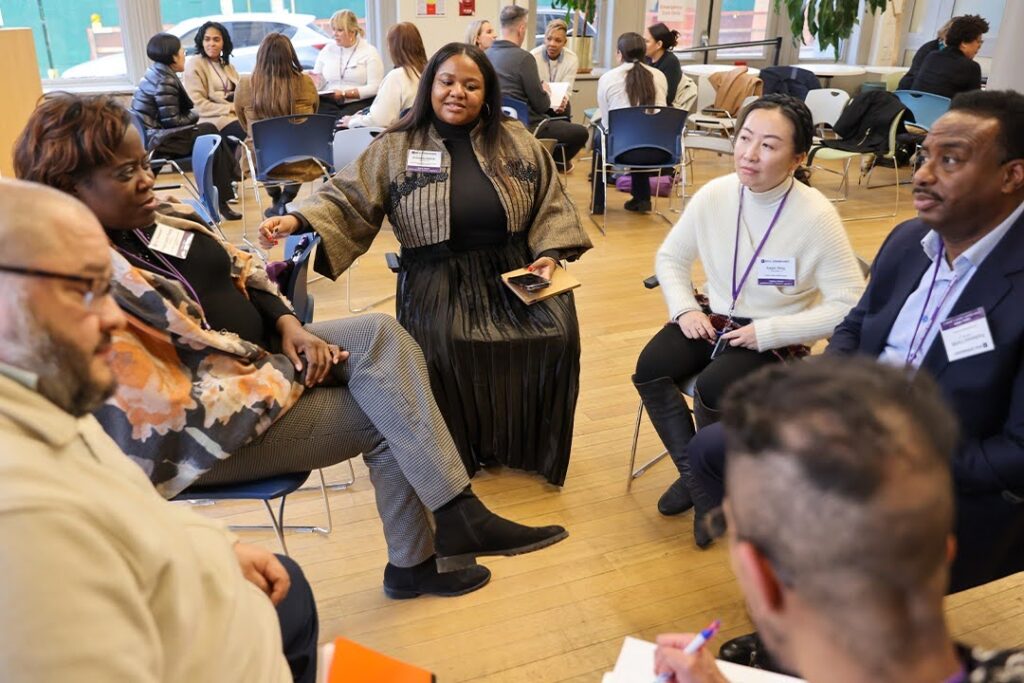
Today’s most pressing leadership challenges are what scholars refer to as “wicked problems”: complex, evolving issues that lack clear solutions and necessitate interdisciplinary thinking. From educational inequity to healthcare access, climate resilience, and institutional bias, these problems are multifaceted and dynamic, making them difficult to define. Because they involve overlapping systems and diverse stakeholders, they can’t be solved by siloed expertise or uniform perspectives. They demand inclusive, cross-disciplinary collaboration.
This philosophy forms the core of the NYU Steinhardt online Doctor of Education in Leadership and Innovation (EdD) program. It brings together a globally diverse cohort of professionals spanning sectors, generations, geographies, races, and lived experiences to foster richer learning and leadership development.
This article examines why diversity of thought and experience is not only beneficial but also a critical tool for innovation, leadership, and real-world problem-solving. It examines how the NYU EdD program harnesses that diversity to challenge assumptions, reframe problems, and prepare students to lead change that is grounded, practical, and far-reaching.
Expand Your Thinking, Expand Your Impact
Lead Change Across Sectors With the NYU Online EdD
The Role of Diversity in Tackling Wicked Problems
Wicked problems are complex, multi-dimensional challenges with no clear or simple solutions. Addressing them effectively requires creativity and cross-disciplinary collaboration. Solutions developed within a single discipline or by homogeneous groups often fall short, relying on familiar methods that can overlook key details and limit innovation. In contrast, diverse teams bring varied perspectives and problem-solving approaches, helping to uncover blind spots and produce stronger outcomes.
As Dr. Lucas Welter (EdD ’23) puts it: “Wicked problems… they’re complex. The answers we know usually don’t work for those problems.”
Recognizing this, the NYU EdD program intentionally recruits students from diverse backgrounds to promote the interdisciplinary thinking and collaboration essential for tackling today’s most pressing real-world challenges.
How Diversity Within the EdD Program Enhances Learning and Research
NYU’s online EdD in Leadership and Innovation brings together students from a wide range of industries, backgrounds, and perspectives to foster deeper dialogue and stronger research. More than a traditional educational leadership degree program, the EdD convenes a global community of professionals driven to lead change in their fields. While many students enter as experts in their domains, exposure to diverse viewpoints challenges them to think beyond disciplinary boundaries and expand their understanding. Through collaboration and open dialogue, students refine their ideas and strengthen their Problem of Practice (POP) research.
Dr. Holly Halmo (EdD ’25) entered the program confident she had already solved her POP, which focused on scaling proactive advising in higher education. “I had a solution. I knew exactly what the problem was. I’ve been trying to fix it for years. … I already had the literature. I was ready to go.” Trained in oral history and ethnography, she initially planned to rely on interviews with students and administrators. But after engaging with faculty and taking research methods courses, she expanded her approach to include quantitative data. “Doing surveys… that [let the] data talk to each other strengthened my argument,” she reflected. This shift enabled her to consider multiple perspectives simultaneously and recognize that the intervention needed to focus on organizational change management, moving beyond individual perspectives to address broader, system-level changes.
Dr. Susan Antolin (EdD ’22), Executive Director of Women for Afghan Women, used her POP to focus on increasing the return on investment for girls of color at independent high schools. As she engaged with cohort members from post-secondary education and the legal field, her POP expanded to address systemic issues affecting educational equity. “I really leaned on people who were in the post-secondary sector, and asked them about systemic challenges, and the student experience there, and that informed my research. And also … those who were in the legal field, and thinking about policy.” Her experience illustrates the program’s encouragement to challenge assumptions. As she puts it: “Don’t be afraid to challenge your assumptions. … You’re going to find out things along the way, from your cohort members, your research, your experience. There are different ways to do things.”
Dr. Julianne Salazar (EdD ’23) emphasized how learning alongside professionals from other sectors broadened her perspective. Coming from a higher education background, she found it eye-opening to engage with classmates tackling similar issues in different industries. “Being able to connect with folks who are not in one sector… I realized they’re dealing with pretty similar challenges,” she said. These cross-sector conversations helped her see problems as systemic rather than personal. With space for reflection and organizational analysis, she gained a more expansive view of her field and a deeper appreciation for how much can be learned from outside it.
Learning Across Generations, Cultures, and Geographies
The NYU EdD cohort model brings together students from different generations, cultures, and global regions, deepening dialogue and expanding the way leadership is understood. These varied life experiences spark new questions, generate fresh ideas, and enrich conversations by encouraging openness to different ways of thinking.
Dr. Nancy Lee Sánchez-Badillo’s journey exemplifies this. As an Afro-Latina advocate for underrepresented students, she has long challenged elitist systems and narrow definitions of success in higher education. “You have to kind of live in that space of being intersectional with many identities that exist in any educational system,” she explains.Her Problem of Practice (POP) focused on expanding access to elite colleges for community college students. By combining data with personal experience, she questioned the assumption that only certain students belong in top-tier institutions. Her message was clear: community college students not only belong but often outperform their peers from more traditional paths. Rather than viewing her identity and background as barriers, she used them to advocate for equity and question who gets seen, supported, and invested in. Her leadership comes from lived experience and a deep belief in the value of persistence, hard work, and community, qualities that may not appear on paper but often lead to new ways of thinking and meaningful, lasting change.
Dr. Alexandra Morgan-Kisarale (EdD ’22) also found that cultural and generational diversity shaped her learning. Her advisor, who grew up in Brooklyn among a large Haitian population, helped her view diaspora issues like “brain drain” through a new lens. A peer from Shanghai prompted her to consider culturally sensitive language more carefully, encouraging her to be more intentional with her communication. She also noted how generational diversity added depth to conversations about leadership styles, digital engagement, and institutional norms. “You can have people who are within the same sector, but are thinking about it differently, or bringing a different life experience to it. And all of those perspectives really add value,” she observed.
These stories underscore how identity, culture, and generational perspective add essential layers to leadership education. They prompt students to think more critically, lead more thoughtfully, and make a lasting impact.
How This Diversity Strengthens Leadership and Innovation
Effective leadership today means working with people who see the world differently. It requires empathy, openness, and the humility to learn from others whose perspectives and methods may differ from your own. Leaders who embrace this are often more adaptable, creative, and inclusive in their approach.
Research indicates that empathetic leadership fosters higher engagement, lower turnover, stronger collaboration, and enhanced well-being. It also helps teams navigate complexity, make better decisions, and operate more inclusively. The ability to build coalitions and lead through uncertainty is now essential across industries.
This understanding is central to the cross-sectoral model in NYU’s EdD in Leadership and Innovation. As Dr. Lucas Welter (EdD ’23) explains: “Cross-sectoral involves this idea of multiple interests—bringing people together from fields that are not easily connected or typically related.” He elaborates, “Everyone has a way of solving problems shaped by their profession or training. The brilliance of cross-sectoral learning is that it brings together those different approaches to uncover new solutions.”
Diversity as a Catalyst for Leadership and Innovation
In the NYU EdD in Leadership and Innovation program, diversity goes beyond representation—it’s a driving force for developing stronger, more effective leaders prepared to address today’s global challenges.
By uniting professionals across sectors, generations, and cultures, the program fosters a learning environment where assumptions are questioned, perspectives are expanded, and ideas are co-created. It’s not just about earning a doctorate; it’s about gaining the adaptability, empathy, insight, and cross-sector network needed to lead in a world defined by complexity and “wicked problems.”
For those seeking a doctoral program experience that challenges their thinking and amplifies their impact, the NYU Steinhardt online EdD offers a compelling path. Schedule a program overview or begin your application to join a cohort where diversity drives real change within individuals, institutions, and society as a whole.