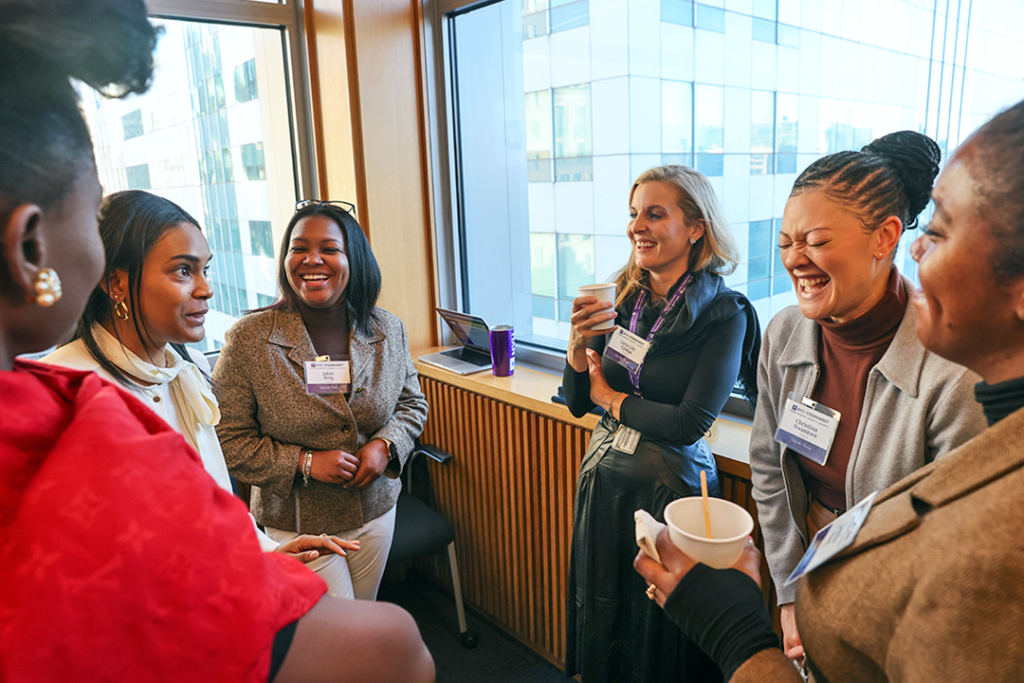
Prospective students weighing an online doctorate often share the same hesitation: can a virtual degree deliver the deep professional connections forged during traditional on-campus programs? For working adults returning to graduate study, concerns about isolation and the absence of a reliable support network are valid.
NYU Steinhardt’s Doctor of Education (EdD) in Leadership and Innovation addresses these challenges structurally. Through a synchronized cohort model, a required on-campus residency, and continuous peer collaboration, the program creates an environment in which professional relationships form immediately and endure well beyond graduation.
Build Lifelong Connections in NYU’s Online EdD
Earn Your Doctorate With Continuous Peer Support
Why Community Matters in a Doctoral Program
Doctoral work requires roughly 15 to 20 hours of weekly coursework alongside full-time employment and the completion of a Problem of Practice, the program’s applied alternative to a conventional dissertation. Rather than leaving peer support to chance, the program embeds collaboration into this workload. As faculty member Dr. Shaden Deleveaux explains, the cohort functions as a “force multiplier” through “symbiotic mutualism”—a structure that enables diverse leaders to “unlock capabilities they otherwise could not access alone.”
How the Cohort Model Creates Ongoing Support
Students progress through all 17 courses as a unified unit. Tyler McCormick, a Cohort 6 graduate, notes that his cohort’s group chat became an essential “lifeline” during intense periods, particularly on “those Sunday nights where you’ve got to turn out a chapter. Working on these pages, you start to feel really low, and then you get a bunch of texts from your cohort reminding you why you’re here.”
Connection often begins prior to formal coursework. Warren Lee, a Cohort 9 student based in Hong Kong, initially questioned whether he could commit to the degree until attending an early virtual event. “I was actually drawn by the cohort,” Lee recalls, noting that the interaction convinced him to go “all in” before setting foot on campus.
The Residency Experience: From Connection to Trust
The three-day in-person residency at NYU at the program’s outset serves as the anchor of the student experience. During the “Why Community Matters” session, students set shared expectations and navigate common anxieties, including imposter syndrome. Student Brian Moreno observed that seeing peers strip away professional titles created immediate “support and belonging,” helping participants “overcome imposter syndrome-which, it turns out, everyone feels even though they are all very talented and accomplished-and begin to feel like you are part of a shared experience.
Sarah Hornung, also of Cohort 9, said the experience delivered on what the program promised: “The program was advertised as really heavy on the community and the camaraderie and the connections that you make in the cohort model,” she said. “I was really overwhelmed with how true that was… I felt so supported.”
At residency, students learn they belong to three overlapping communities that will support them: academic (cohort and faculty), professional (mentors and colleagues), and personal (family and friends).
Maintaining Community Across Distance
Peer interaction continues past the initial residency through student-led initiatives. Program co-founder Dr. Noel Anderson points out these occur regularly without administrative prompting, as students independently organize face-to-face gatherings across different cities. “The activity around regional meetups happen all the time,” he said. “Students are taking the initiative on their own… For example, we have folks from Cohort 8 who are meeting in New York right now.”
This network provides both academic and personal backing. Jasmine N. Hawkins-White, a clinical assistant professor and program alumna, recalls needing to lean on her peers during a family crisis: “I’m really glad during that one group project I could say, hey, they’ve put my grandmother in hospice. I’m literally sitting at her bedside watching her slip away. Can somebody take this slide deck right now?”
Long-Term Professional Networks
The cohort structure creates professional capital that extends beyond degree completion. Felipe Henao, a Cohort 1 alumnus, notes that his group established a communications channel during their studies that remains active years later for “holidays, major event changes, [and] life updates,” maintaining a tight-knit network throughout their respective careers.
For prospective students evaluating online options, the cohort model offers a structured framework ensuring that advanced academic work is backed by a sustained, collaborative network.
Next Steps: Experience the Cohort Model for Yourself
Prospective students don’t have to take community on faith. Connect with an enrollment advisor to learn more about the cohort experience, or start an application to join a program built on the idea that no one earns a doctorate alone.